The Pulse on Perfusion: Is Non-Cardiac Autotransfusion an Untapped Opportunity?
Every unit of donor blood avoided can make a meaningful difference for patients and healthcare systems alike. Yet despite advances in patient blood management, many clinicians believe one proven strategy continues to be overlooked. This month’s Pulse on Perfusion explores how the profession views the current use of non-cardiac autotransfusion, the barriers limiting its adoption, and where the greatest opportunities may lie. The responses reveal broad agreement that the technology has value, but a more nuanced conversation about what is preventing it from reaching its full potential.
Poll Results at a Glance
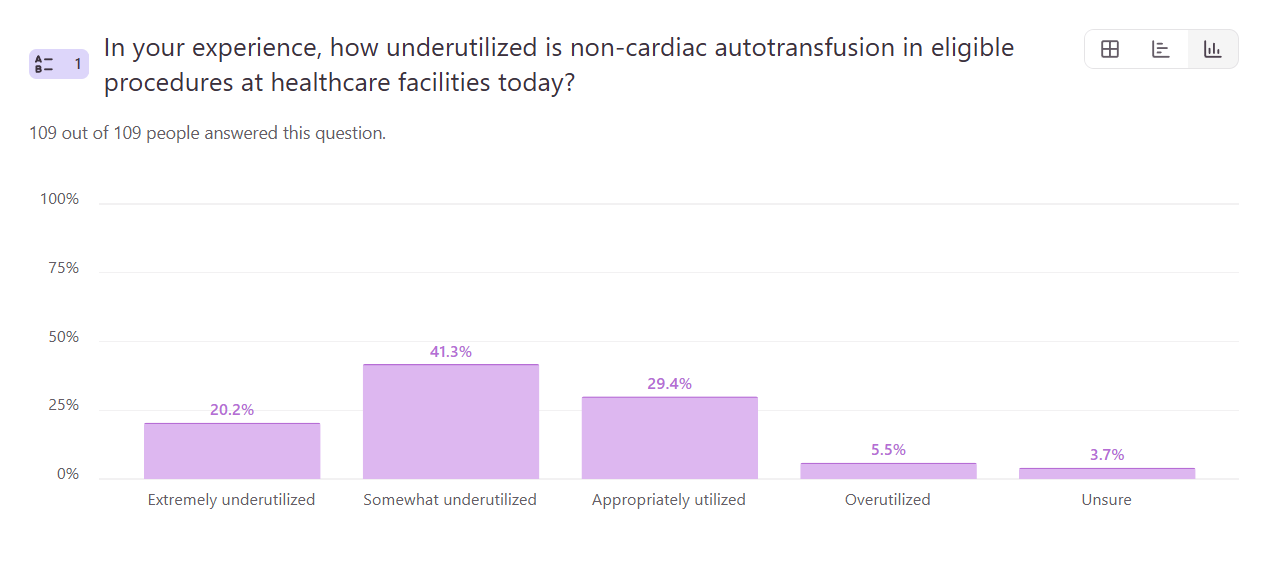
Question 1: In your experience, how underutilized is non-cardiac autotransfusion in eligible procedures at healthcare facilities today?
- Somewhat underutilized – 40.2%
- Extremely underutilized – 21.6%
- Appropriately utilized – 28.4%
- Overutilized – 5.9%
- Unsure – 3.9%
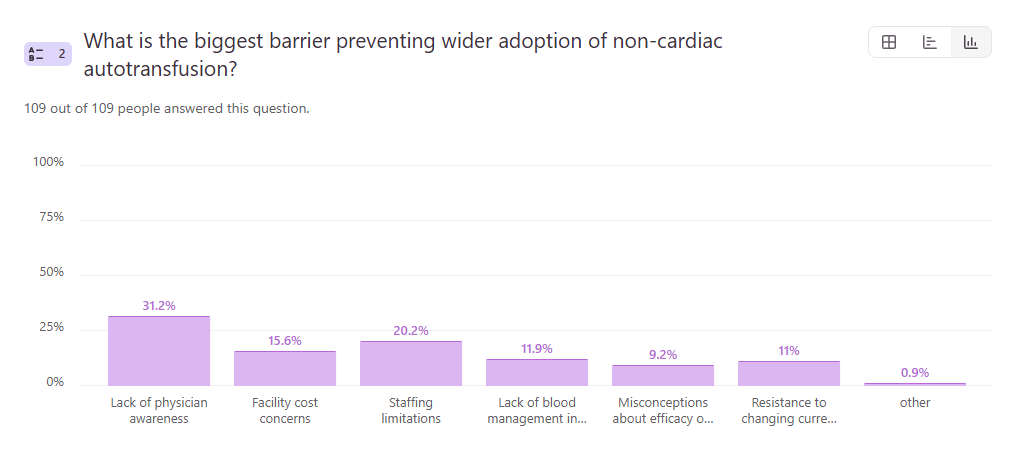
Question 2: What is the biggest barrier preventing wider adoption of non-cardiac autotransfusion?
- Lack of physician awareness – 31.4%
- Staffing limitations – 18.6%
- Facility cost concerns – 14.7%
- Lack of blood management initiatives/protocols – 12.7%
- Resistance to changing current practices – 11.8%
- Misconceptions about efficacy or safety – 9.8%
- Other – 1%
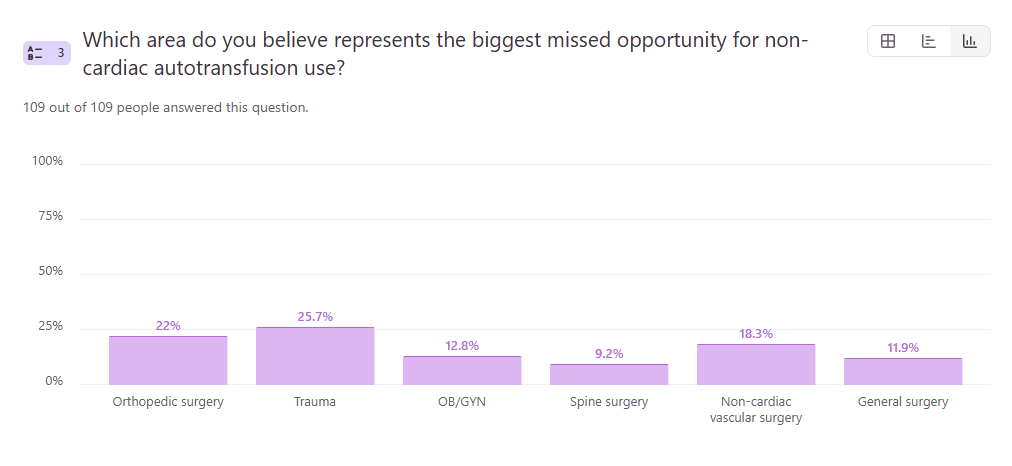
Question 3: Which area represents the biggest missed opportunity for non-cardiac autotransfusion use?
- Trauma – 24.5%
- Orthopedic surgery – 22.5%
- Non-cardiac vascular surgery – 19.6%
- OB/GYN – 12.7%
- General surgery – 10.8%
- Spine surgery – 9.8%
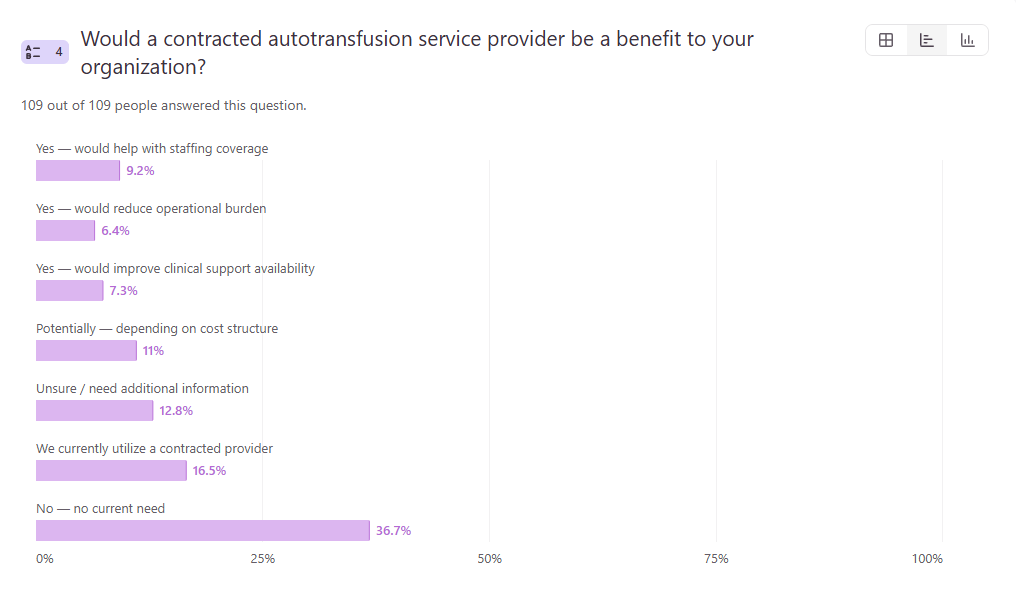
Question 4: Would a contracted autotransfusion service provider be a benefit to your organization?
- No, no current need – 36.3%
- We currently utilize a contracted provider – 16.7%
- Potentially, depending on cost structure – 11.8%
- Unsure / need additional information – 11.8%
- Yes, would help with staffing coverage – 9.8%
- Yes, would improve clinical support availability – 7.8%
- Yes, would reduce operational burden – 5.9%
Question 5: Do you believe non-cardiac autotransfusion is the most underused patient blood management tool today?
Respondents shared a wide range of perspectives, with the majority believing it remains significantly underutilized, while others pointed to financial, clinical, and operational considerations that influence its use.
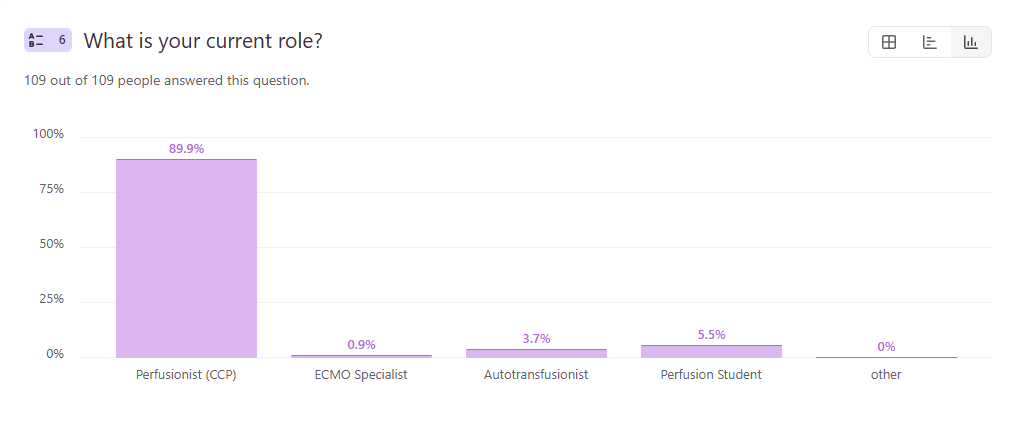
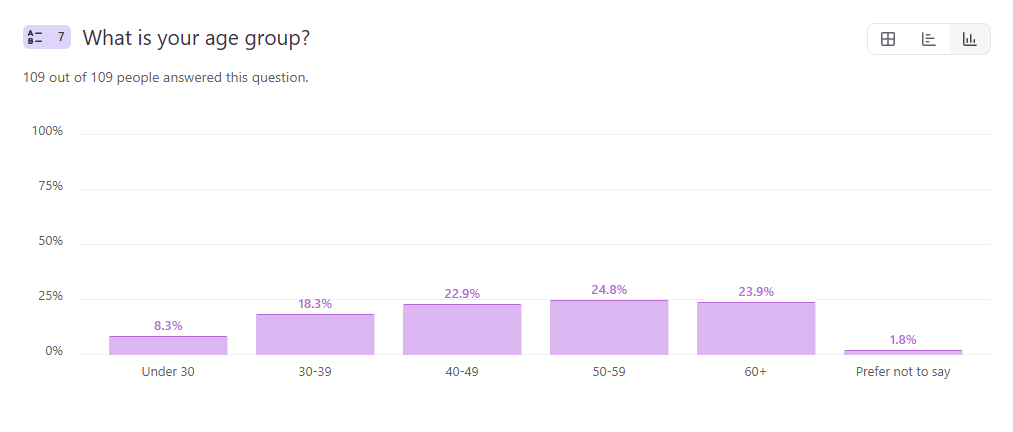
Although this poll focused on non-cardiac autotransfusion, the responses primarily reflect the perspectives of practicing perfusionists, who made up 89.2% of respondents, while autotransfusionists represented just 3.9%. This offers valuable insight into how the broader perfusion community views the current role of autotransfusion, the barriers to wider adoption, and where opportunities for growth may exist.
Question 1: Is Non-Cardiac Autotransfusion Being Underutilized?
Nearly two-thirds of respondents (61.8%) believe non-cardiac autotransfusion is either somewhat or extremely underutilized in eligible procedures. By comparison, fewer than one-third feel current utilization is appropriate, and only a small minority (5.9%) believes it is overused.
These results suggest that many clinicians see meaningful opportunities to expand autotransfusion as part of patient blood management, particularly in procedures where blood loss is anticipated but the technology may not be routinely considered. At the same time, the 28.4% who believe current utilization is appropriate indicates that adoption likely varies between institutions. Some hospitals may already have established protocols and consistent utilization, while others have significant room for improvement.
Question 2: What’s Holding Adoption Back?
Physician awareness emerged as the leading barrier to wider adoption, selected by 31.4% of respondents. Staffing limitations (18.6%) and facility cost concerns (14.7%) followed, while respondents also pointed to gaps in blood management protocols (12.7%) and resistance to changing established practices (11.8%). Rather than identifying one overwhelming obstacle, the results suggest that adoption is influenced by several interconnected challenges.
One of the more notable findings is that respondents were far more likely to cite awareness than concerns about the technology itself. Only 9.8% selected misconceptions about efficacy or safety, indicating that most participants view non-cardiac autotransfusion as a clinically sound intervention. Instead, the greater challenge appears to be ensuring physicians recognize when it is appropriate, hospitals have the staffing and protocols to support it, and organizations are willing to invest in expanding patient blood management initiatives.
Taken together, these responses suggest that increasing utilization is less about proving the value of autotransfusion and more about bridging the gap between evidence and implementation. Even when clinicians believe the technology can benefit patients, adoption may stall if awareness, staffing, financial considerations, and institutional processes are not aligned.
Question 3: Where Are the Biggest Opportunities?
Trauma (24.5%), orthopedic surgery (22.5%), and non-cardiac vascular surgery (19.6%) emerged as the areas respondents believe represent the greatest missed opportunities for non-cardiac autotransfusion. These specialties are often associated with significant blood loss, making them logical candidates for broader use of blood conservation strategies.
What makes these results particularly interesting is how evenly the responses were distributed. While trauma received the highest percentage, no specialty captured more than one-quarter of the vote, and every option received meaningful support. This suggests respondents do not view underutilization as a challenge confined to one clinical area. Instead, they see opportunities across a wide range of surgical specialties where patient blood management could play a larger role.
The results also reinforce a theme that emerged in the previous question. If physician awareness, institutional protocols, and staffing are the primary barriers, expanding non-cardiac autotransfusion may depend less on identifying new clinical applications and more on increasing awareness of existing ones. Rather than focusing on a single specialty, respondents appear to believe that broader education and more consistent implementation could help eligible patients across multiple surgical disciplines benefit from autotransfusion.
Question 4: The Role of Contracted Services
Responses to this question reflect the reality that there is no one-size-fits-all staffing model. While the largest group (36.3%) reported no current need for a contracted autotransfusion provider, nearly one in six respondents already use one, and another 39.2% either saw potential value or wanted additional information before deciding.
Cost clearly plays an important role in the discussion. More respondents selected “Potentially, depending on cost structure” than any individual “Yes” response, suggesting that organizations may recognize the clinical benefits while weighing the financial realities of implementing or expanding these services. The results indicate that adoption often depends less on whether contracted support is valuable and more on whether it makes operational and economic sense for a particular facility.
Question 5: Is Non-Cardiac Autotransfusion the Most Underused Patient Blood Management Tool Today?
While the poll results show that many respondents believe non-cardiac autotransfusion is underutilized, the written comments reveal a more nuanced conversation. Rather than simply advocating for increased use, respondents discussed the practical realities that influence adoption, from physician awareness and staffing to cost, reimbursement, and clinical judgment. Although opinions differed on whether non-cardiac autotransfusion is the single most underused patient blood management tool, several common themes emerged.
Awareness Remains the Biggest Hurdle
For many respondents, the biggest obstacle isn’t the technology itself, but awareness. Several comments pointed to limited physician familiarity, inconsistent education, and misconceptions about blood loss as reasons why autotransfusion isn’t considered more often.
“Yes! It is highly underutilized due to lack of physician awareness and lack of promotion due to staffing and educational deficiencies.”
Others focused on how blood loss is assessed in practice. One respondent wrote:
“Doctors I believe [underestimate] their blood loss, therefore they feel that they do not need a cell saver.”
Another added:
“Yes most physicians are unaware of the benefits of it.”
Together, these responses suggest that greater education could lead to more consistent use in appropriate cases.
Cost and Operational Realities
Many respondents also acknowledged that practical considerations influence adoption. Staffing availability, equipment costs, reimbursement challenges, and workflow all affect whether autotransfusion is feasible, even when clinicians recognize its clinical value.
One respondent summarized the issue well, noting that adoption remains inconsistent because of “lack of standardized protocols, limited training and awareness, staffing and workflow challenges, and cost perceptions.”
These comments reinforce that increasing utilization requires organizational commitment alongside clinical advocacy.
When Autotransfusion Isn’t the Right Answer
While the majority of respondents believe non-cardiac autotransfusion is underutilized, a notable group of “no” responses pointed to concerns about overuse, cost-effectiveness, and clinical necessity in certain settings.
One respondent emphasized appropriate case selection:
“No, in my experience it has been over utilized waiting hours for a case and not receiving enough blood to return.”
This perspective highlights an operational concern that resonates in lower-blood-loss cases, where setup time and resource utilization may outweigh clinical benefit.
Others pointed to broader limitations in value and applicability:
“No, there are other techniques that would have a greater impact.”
and
“Not really, there are newer techniques that show more promise for patient outcomes.”
These responses suggest that for some clinicians, non-cardiac autotransfusion is not viewed as the most impactful lever in patient blood management, particularly as other strategies continue to evolve.
There were also concerns about safety, workflow complexity, and system constraints:
“Limitations of what can actually be processed; unclean blood and many, many glue products and/or infectious diseases.”
Taken together, these responses reflect a more nuanced form of skepticism. Rather than rejecting autotransfusion outright, these clinicians are questioning its relative value, efficiency, and prioritization compared with other emerging or established approaches. This reinforces that the conversation is not only about increasing utilization, but also about ensuring it is used where it provides clear and measurable benefit.
A Shared Goal: Better Patient Blood Management
Despite differing opinions on utilization, nearly every response centered on the same objective: improving patient care. Whether respondents advocated for broader adoption, stronger education, or more selective use, the conversation consistently returned to optimizing patient blood management.
One respondent captured that sentiment simply:
“Why not use it? It does nothing but benefit the patient and isn’t that why we are all here?”
Taken together, the responses suggest that while clinicians may disagree on how often non-cardiac autotransfusion should be used, they largely agree on what should guide those decisions: delivering the best possible care for each patient.
Reflections on Non-Cardiac Autotransfusion
This month’s poll highlights broad agreement that non-cardiac autotransfusion deserves greater consideration as part of patient blood management strategies. At the same time, the responses make it clear that increasing utilization will require more than additional equipment or staffing. Education, physician engagement, institutional support, and evidence-based protocols all play an important role.
As healthcare continues to prioritize blood conservation and patient-centered care, the conversation is shifting from whether non-cardiac autotransfusion has value to how it can be integrated more consistently and effectively. The responses suggest there is still a significant opportunity to close that gap.
Stay tuned for the next Pulse on Perfusion as the series continues to share insights from across the community.
Appendix of Additional Insights
- Autotransfusionists were even more likely to perceive underutilization. Three of the four autotransfusionists who responded described non-cardiac autotransfusion as extremely underutilized, while the fourth believed it is appropriately utilized.
- Perfusionists also leaned toward greater utilization. Among perfusionists, 61.5% selected either extremely underutilized or somewhat underutilized, reinforcing the overall sentiment that opportunities remain to expand its use.
- Written comments strongly favored greater adoption. Of respondents who submitted comments for Question 5, 61.67% believed non-cardiac autotransfusion is the most underused patient blood management tool today, while 33.33% disagreed, and the remainder were unsure. This reflects broad support for expanded use, even as respondents acknowledged practical and financial challenges.